
 on December 8, 2025
Simple NT-proBNP blood test should be made compulsory for access to specialist services in order to drive earlier diagnosis and relieve pressure on secondary care.
Our new report warns that the condition is being routinely missed and not properly managed in primary care, leaving hundreds of thousands of people at risk of avoidable hospitalisation and premature death.
The report, Transforming Heart Failure Services in the Community, draws on five years of clinical evidence, patient testimony and frontline experience. It has found:
- Despite widespread availability, NT-proBNP testing is still not being used correctly to quickly rule out heart failure
- Suspected cases of heart failure are being wrongly referred to specialist services without having undergone NT-proBNP testing, creating unsustainable pressure on specialist and echocardiography services
- Management of the condition after discharge from hospital is patchy, with many patients not receiving optimal guideline based therapy nor undergoing life-enhancing cardiac rehabilitation.
Heart failure is one of the fastest growing major conditions. Around one million people in the UK are living with the condition, with 200,000 new cases every year. Alongside this, there are an estimated 385,000 people across the UK who remain undiagnosed and at risk of severe illness and hospitalisation.
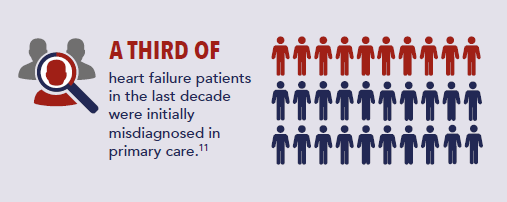
Heart failure is also one of the most commonly misdiagnosed major conditions on the NHS. In recent years, guidelines have enhanced the role of primary care in diagnosing and managing the disease.
However, the Alliance’s report argues that primary care is currently severely underutilised when it comes to tackling the growing burden of the illness.
The report lays out a series of recommendations to manage the growing burden of heart failure via primary care based on the best performing services in the country. It also recommends the enhanced screening of the condition through Community Diagnostic Centres and pharmacies to ensure faster access to life-saving care.
Patient stories highlight failings in primary care
80% of heart failure patients are diagnosed in hospital, despite half of them having had signs and symptoms that could have triggered an earlier assessment in primary care. One patient, Katie, was repeatedly misdiagnosed before arriving at A&E with heart function at just 17%.
“Primary care is where heart failure begins and where it ends,” she told the Alliance. “But GPs need support. They need in-depth training in heart failure, the confidence to prescribe the right medications, and access to the right diagnostics.”
Another patient, Emily, who spoke anonymously to the Alliance, was diagnosed during a hospital admission after having a stroke, but only found out a year later that she was suffering from heart failure and required urgent access to treatment.
She told the Alliance that she is still struggling to manage her condition in the community: “If my heart failure nurse or cardiologist changes my prescription, it doesn’t go through to my GP automatically. I have to make calls, chase things up – it’s frustrating, and frankly, it’s not safe. The system is clunky, and doesn’t seem to prioritise heart failure.”

Dr Jim Moore, GP with Specialist Interest in Cardiovascular Medicine and Immediate Past President Primary Care Cardiovascular Society, said:
“Heart failure is one of the major long term health conditions facing the NHS. Yet despite advances in diagnostics and treatment, it is not being properly prioritised in primary care in line with other major conditions.
“The Alliance’s report presents a series of solutions and recommendations based on the highest performing services in the country that provide health leaders and the government with a roadmap to transform care and ensure we are ready for one of the major health challenges of the 21st century.
“Better use of a simple diagnostic NT-proBNP is the key to this transformation. Too many who present with symptoms are not being offered the test which can quickly rule out heart failure.
“Training more healthcare professionals to correctly use this test, and expanding screening for heart failure in pharmacies and Community Diagnostic Centres can save lives, ease pressure on hospitals and free up vital resources.”